 eb7eb9c5a1
* fix: resolve logic errors in ahm heal module

- Fix response publishing logic in HealChannelProcessor to properly handle errors
- Fix negative index handling in DiskStatusChange event to fail fast instead of silently converting to 0
- Enhance timeout control in heal_erasure_set Step 3 loop to immediately respond to cancellation/timeout
- Add proper error propagation for task cancellation and timeout in bucket healing loop

* fix: stabilize performance impact measurement test

- Increase measurement count from 3 to 5 runs for better stability
- Increase workload from 5000 to 10000 operations for more accurate timing
- Use median of 5 measurements instead of single measurement
- Ensure with_scanner duration is at least baseline to avoid negative overhead
- Increase wait time for scanner state stabilization

* wip

* Update crates/ahm/src/heal/channel.rs

Co-authored-by: Copilot <175728472+Copilot@users.noreply.github.com>

* refactor: remove redundant ok_or_else + expect in event.rs

Replace redundant ok_or_else() + expect() pattern with
unwrap_or_else() + panic!() to avoid creating unnecessary Error
type when the value will panic anyway. This also defers error
message formatting until the error actually occurs.

* Update crates/ahm/src/heal/task.rs

Co-authored-by: Copilot <175728472+Copilot@users.noreply.github.com>

* fix(ahm): fix logic errors and add unit tests

- Fix panic in HealEvent::to_heal_request for invalid indices
- Replace unwrap() calls with proper error handling in resume.rs
- Fix race conditions and timeout calculation in task.rs
- Fix semaphore acquisition error handling in erasure_healer.rs
- Improve error message for large objects in storage.rs
- Add comprehensive unit tests for progress, event, and channel modules
- Fix clippy warning: move test module to end of file in heal_channel.rs

* style: apply cargo fmt formatting

* refactor(ahm): address copilot review suggestions

- Add comment to check_control_flags explaining why return value is discarded
- Fix hardcoded median index in performance test using constant and dynamic calculation

---------

Co-authored-by: Copilot <175728472+Copilot@users.noreply.github.com>

RustFS is a high-performance distributed object storage software built using Rust


Getting Started · Docs · Bug reports · Discussions
English | 简体中文 | Deutsch | Español | français | 日本語 | 한국어 | Portuguese | Русский
RustFS is a high-performance distributed object storage software built using Rust, one of the most popular languages worldwide. Along with MinIO, it shares a range of advantages such as simplicity, S3 compatibility, open-source nature, support for data lakes, AI, and big data. Furthermore, it has a better and more user-friendly open-source license in comparison to other storage systems, being constructed under the Apache license. As Rust serves as its foundation, RustFS provides faster speed and safer distributed features for high-performance object storage.
⚠️ RustFS is under rapid development. Do NOT use in production environments!
Features
- High Performance: Built with Rust, ensuring speed and efficiency.
- Distributed Architecture: Scalable and fault-tolerant design for large-scale deployments.
- S3 Compatibility: Seamless integration with existing S3-compatible applications.
- Data Lake Support: Optimized for big data and AI workloads.
- Open Source: Licensed under Apache 2.0, encouraging community contributions and transparency.
- User-Friendly: Designed with simplicity in mind, making it easy to deploy and manage.
RustFS vs MinIO
Stress test server parameters
| Type | parameter | Remark |
|---|---|---|
| CPU | 2 Core | Intel Xeon(Sapphire Rapids) Platinum 8475B , 2.7/3.2 GHz |
| Memory | 4GB | |
| Network | 15Gbp | |
| Driver | 40GB x 4 | IOPS 3800 / Driver |
https://github.com/user-attachments/assets/2e4979b5-260c-4f2c-ac12-c87fd558072a
RustFS vs Other object storage
| RustFS | Other object storage |
|---|---|
| Powerful Console | Simple and useless Console |
| Developed based on Rust language, memory is safer | Developed in Go or C, with potential issues like memory GC/leaks |
| Does not report logs to third-party countries | Reporting logs to other third countries may violate national security laws |
| Licensed under Apache, more business-friendly | AGPL V3 License and other License, polluted open source and License traps, infringement of intellectual property rights |
| Comprehensive S3 support, works with domestic and international cloud providers | Full support for S3, but no local cloud vendor support |
| Rust-based development, strong support for secure and innovative devices | Poor support for edge gateways and secure innovative devices |
| Stable commercial prices, free community support | High pricing, with costs up to $250,000 for 1PiB |
| No risk | Intellectual property risks and risks of prohibited uses |
Quickstart
To get started with RustFS, follow these steps:
- One-click installation script (Option 1)
curl -O https://rustfs.com/install_rustfs.sh && bash install_rustfs.sh
- Docker Quick Start (Option 2)
 # create data and logs directories
 mkdir -p data logs

 # using latest alpha version
 docker run -d -p 9000:9000 -v $(pwd)/data:/data -v $(pwd)/logs:/logs rustfs/rustfs:alpha

 # Specific version
 docker run -d -p 9000:9000 -v $(pwd)/data:/data -v $(pwd)/logs:/logs rustfs/rustfs:1.0.0.alpha.45
For docker installation, you can also run the container with docker compose. With the docker-compose.yml file under
root directory, running the command:
docker compose --profile observability up -d
NOTE: You should be better to have a look for docker-compose.yaml file. Because, several services contains in the
file. Grafan,prometheus,jaeger containers will be launched using docker compose file, which is helpful for rustfs
observability. If you want to start redis as well as nginx container, you can specify the corresponding profiles.
-
Build from Source (Option 3) - Advanced Users
For developers who want to build RustFS Docker images from source with multi-architecture support:
# Build multi-architecture images locally
./docker-buildx.sh --build-arg RELEASE=latest

# Build and push to registry
./docker-buildx.sh --push

# Build specific version
./docker-buildx.sh --release v1.0.0 --push

# Build for custom registry
./docker-buildx.sh --registry your-registry.com --namespace yourname --push
The
docker-buildx.shscript supports:- Multi-architecture builds:
linux/amd64,linux/arm64 - Automatic version detection: Uses git tags or commit hashes
- Registry flexibility: Supports Docker Hub, GitHub Container Registry, etc.
- Build optimization: Includes caching and parallel builds
You can also use Make targets for convenience:
make docker-buildx # Build locally make docker-buildx-push # Build and push make docker-buildx-version VERSION=v1.0.0 # Build specific version make help-docker # Show all Docker-related commands - Multi-architecture builds:
-
Build with helm chart(Option 4) - Cloud Native environment
Following the instructions on helm chart README to install RustFS on kubernetes cluster.
-
Access the Console: Open your web browser and navigate to
http://localhost:9000to access the RustFS console, default username and password isrustfsadmin. -
Create a Bucket: Use the console to create a new bucket for your objects.
-
Upload Objects: You can upload files directly through the console or use S3-compatible APIs to interact with your RustFS instance.
NOTE: If you want to access RustFS instance with https, you can refer
to TLS configuration docs.
Documentation
For detailed documentation, including configuration options, API references, and advanced usage, please visit our Documentation.
Getting Help
If you have any questions or need assistance, you can:
- Check the FAQ for common issues and solutions.
- Join our GitHub Discussions to ask questions and share your experiences.
- Open an issue on our GitHub Issues page for bug reports or feature requests.
Links
- Documentation - The manual you should read
- Changelog - What we broke and fixed
- GitHub Discussions - Where the community lives
Contact
- Bugs: GitHub Issues
- Business: hello@rustfs.com
- Jobs: jobs@rustfs.com
- General Discussion: GitHub Discussions
- Contributing: CONTRIBUTING.md
Contributors
RustFS is a community-driven project, and we appreciate all contributions. Check out the Contributors page to see the amazing people who have helped make RustFS better.

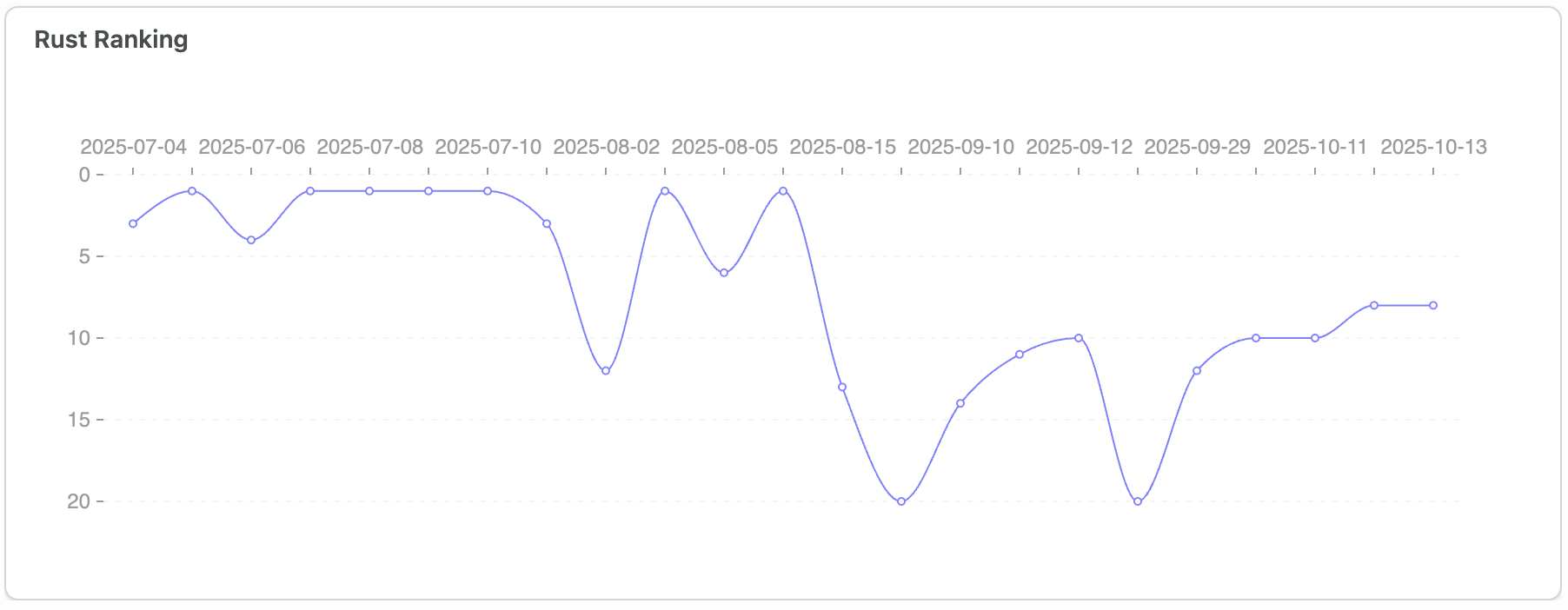
Github Trending Top
🚀 RustFS is beloved by open-source enthusiasts and enterprise users worldwide, often appearing on the GitHub Trending top charts.
Star History
License
RustFS is a trademark of RustFS, Inc. All other trademarks are the property of their respective owners.